 Blog
Blog


 Nederlands
 Deutsch
 Español
 Magyar
Kanna vs Kratom: A Scientific Comparison of Two Botanical Species

Jun
Kanna vs Kratom: Two Different Botanicals With Different Scientific Profiles
Kratom and kanna are sometimes discussed in similar botanical or ethnobotanical contexts, but they are scientifically distinct plants with different origins, chemical profiles, pharmacological mechanisms, and safety considerations.
Kanna, botanically known as Sceletium tortuosum, is a succulent plant native to southern Africa. Scientific literature focuses mainly on its mesembrine-type alkaloids, including mesembrine, mesembrenone, mesembrenol, and related compounds.
Kratom, botanically known as Mitragyna speciosa, is a tropical tree native to Southeast Asia. Its research profile is centered mainly on mitragynine and 7-hydroxymitragynine, two alkaloids associated with complex receptor activity, including opioid-receptor-related pharmacology.
So this article compares kanna and kratom from a botanical, chemical, pharmacological, and safety-research perspective. Above all it is intended for educational and scientific purposes only and does not provide preparation, serving, dosage, or product-use guidance.
However for more category-level information, see our pages on Kanna / Sceletium tortuosum and Kratom / Mitragyna speciosa.
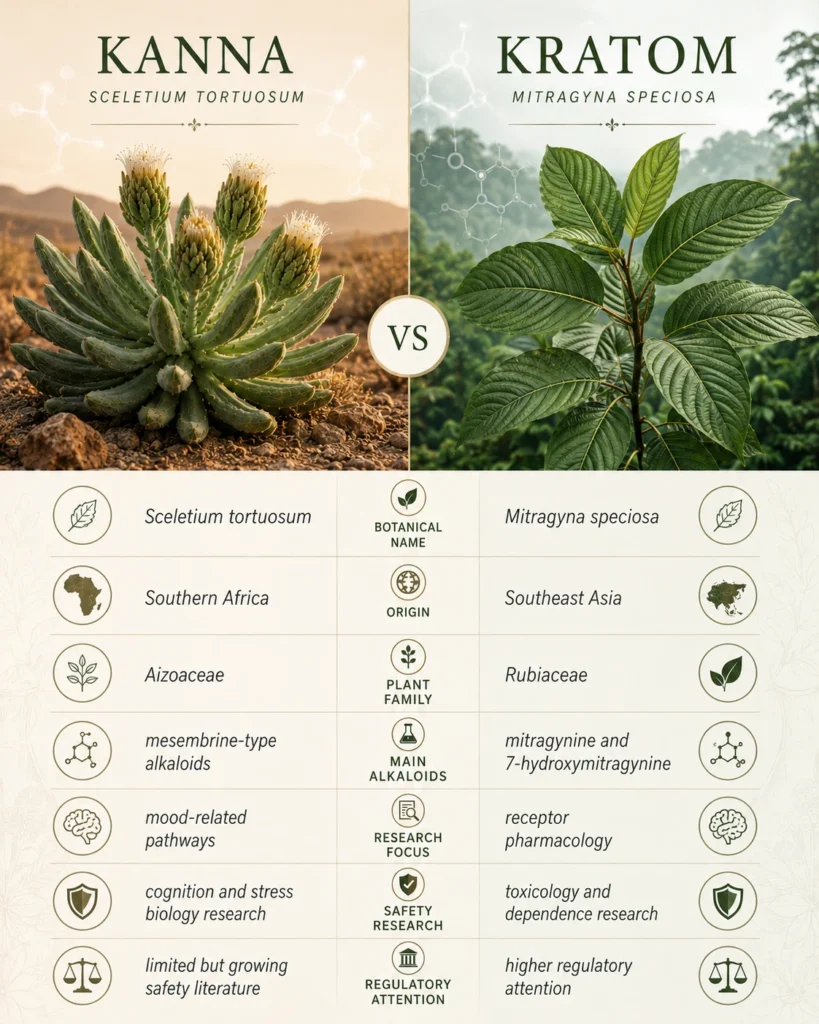
Quick Comparison: Kanna vs Kratom
| Category | Kanna | Kratom |
|---|---|---|
| Botanical name | Sceletium tortuosum | Mitragyna speciosa |
| Plant family | Aizoaceae | Rubiaceae |
| Geographic origin | Southern Africa | Southeast Asia |
| Main alkaloids | Mesembrine, mesembrenone, mesembrenol | Mitragynine, 7-hydroxymitragynine |
| Main research focus | Mood-related pathways, cognition, stress biology, alkaloid chemistry | Alkaloid pharmacology, opioid-receptor activity, toxicology, dependence research |
| Key scientific distinction | Mesembrine-type alkaloid profile | Mitragynine-based alkaloid profile |
| Safety research | Limited but expanding | Larger toxicology and public-health literature |
| Regulatory attention | Generally lower | Higher, especially due to opioid-receptor-related concerns |
What Is Kanna?
Kanna refers to Sceletium tortuosum, a succulent plant indigenous to southern Africa. In scientific literature, the plant is primarily discussed for its characteristic alkaloid profile, especially mesembrine-type alkaloids.
Research on Sceletium tortuosum has examined topics such as:
- phytochemistry
- alkaloid standardisation
- cognitive research
- mood-related pathways
- stress-response models
- safety and tolerability of standardised extracts
A key point in the scientific literature is that kanna research remains relatively limited compared with many established pharmaceutical or nutraceutical compounds. Existing studies and reviews describe promising research areas, but also emphasise the need for larger and more rigorous clinical investigations.
Key Kanna Compounds
The most discussed kanna alkaloids include:
- Mesembrine
- Mesembrenone
- Mesembrenol
- Mesembranol
Consequently these compounds are central to the scientific distinction between kanna and kratom. Kanna research is generally associated with mesembrine-type alkaloids, while kratom research is associated mainly with mitragynine-type alkaloids.
What Is Kratom?
Kratom refers to Mitragyna speciosa, a tropical tree in the coffee family, Rubiaceae. It is native to parts of Southeast Asia and has become a major subject in pharmacology, toxicology, public-health, and regulatory research.
Consequently the two most widely discussed kratom alkaloids are:
- Mitragynine
- 7-hydroxymitragynine
Scientific studies have examined how these alkaloids interact with biological systems, including opioid receptors. This receptor profile helps explain why researchers and regulators often distinguish kratom from kanna in scientific and regulatory discussions.
So kratom research often focuses on:
- alkaloid chemistry
- receptor pharmacology
- toxicology
- product variability
- dependence and withdrawal literature
- public-health monitoring
- safety concerns related to concentrated alkaloid products
Kanna and Kratom Have Different Alkaloid Profiles
The most important scientific difference between kanna and kratom is their alkaloid chemistry.
Kanna is primarily associated with mesembrine-type alkaloids, while kratom is primarily associated with mitragynine-type alkaloids.
This distinction matters because alkaloids strongly influence how a plant is studied in pharmacology and toxicology. Even when commercial or ethnobotanical contexts compare two botanicals, their chemistry can place them in very different scientific categories.
Kanna: Mesembrine-Type Alkaloids
So mesembrine and related compounds are the main focus of kanna research. Therefore reviews on Sceletium tortuosum describe these alkaloids as key markers for phytochemical identification and pharmacological study.
Kratom: Mitragynine-Type Alkaloids
Mitragynine is the dominant alkaloid discussed in kratom research, while 7-hydroxymitragynine receives significant attention because of its potency and opioid-receptor-related pharmacology. These compounds place kratom in a more complex and more heavily scrutinised research category.
Pharmacological kanna vs kratom Comparison
From a pharmacological perspective, kanna and kratom should not be treated as interchangeable botanicals.
Kanna research is more commonly associated with:
- mesembrine-type alkaloids
- serotonin-related research pathways
- phosphodiesterase-4-related research
- cognitive and stress-response studies
- mood-related scientific models
Kratom research is more commonly associated with:
- mitragynine and 7-hydroxymitragynine
- opioid-receptor-related pharmacology
- toxicology and safety monitoring
- dependence and withdrawal literature
- alkaloid concentration variability
The scientific distinction is clear: kanna research centers on mesembrine-type alkaloids, while kratom research centers on mitragynine-type alkaloids and opioid-receptor pharmacology.
Safety Research: Kanna vs Kratom
Safety research is another major difference between kanna and kratom.
Kanna Safety Research
Kanna has a smaller safety literature. Some studies on standardised Sceletium tortuosum extracts have examined tolerability and safety markers, but the total clinical evidence base remains limited.
Important limitations include:
- small study sizes
- limited long-term data
- limited clinical-population data
- product-standardisation differences
- incomplete interaction research
Because the research base is still developing, scientific claims around kanna should remain cautious and evidence-based.
Kratom Safety Research
Kratom has a larger and more complex safety literature. So research and public-health discussions have examined dependence, withdrawal, product variability, contamination, alkaloid concentration, and adverse-event reports.
However a major scientific concern is that kratom products can vary substantially in alkaloid composition. Researchers often separate concentrated products and isolated alkaloid formulations from natural botanical material in scientific discussions because their chemical profiles may differ significantly.
Kratom therefore has a more prominent risk and regulatory profile than kanna.
Research Strengths and Limitations
Kanna Research Strengths
Kanna research benefits from a clearly defined group of characteristic alkaloids and a growing number of phytochemical and clinical publications. However scientific reviews describe Sceletium tortuosum as an important southern African botanical with promising research directions.
Kanna Research Limitations
The kanna evidence base remains early-stage. Researchers need larger studies, longer follow-up periods, and more diverse clinical data before drawing strong conclusions about kanna.
Research Strengths
Kratom has been studied extensively in pharmacology, toxicology, and public-health literature. Kratom research focuses heavily on its main alkaloids, especially mitragynine, as central targets in pharmacology and toxicology studies.
Research Limitations
Despite the larger literature, kratom research remains complicated by variability in alkaloid composition, differences between traditional botanical material and concentrated products, and limited high-quality clinical evidence.
Kanna vs Kratom: Which Has More Regulatory Attention?
Kratom has substantially more regulatory and public-health attention than kanna. This is largely due to its opioid-receptor-related pharmacology, safety reports, dependence literature, and concerns around concentrated alkaloid products.
However kanna research more often focuses on botany, phytochemistry, mood-related pathways, and cognitive studies.
In conclusion this does not mean that kanna is risk-free. So it means that the scientific and regulatory concerns surrounding the two plants are different in type and scale.
Summary: Main Differences Between Kanna and Kratom
So kanna and kratom are different botanical species with different chemical and pharmacological profiles.
Kanna is Sceletium tortuosum, is in short a southern African succulent associated mainly with mesembrine-type alkaloids and research most importantly into mood-related, cognitive, and stress-response pathways.
Kratom is Mitragyna speciosa, in conclusion a Southeast Asian tree associated mainly with mitragynine and 7-hydroxymitragynine, with research focused on receptor pharmacology, toxicology, dependence, and safety monitoring.
The most important difference is that kanna is generally studied through the lens of mesembrine-type alkaloid research, while kratom is studied through the lens of mitragynine-type alkaloid research and opioid-receptor-related pharmacology.
For related category information, visit:
Frequently Asked Questions
So is kanna the same as kratom?
No. Kanna and kratom are different plants. Kanna is Sceletium tortuosum, while kratom is Mitragyna speciosa. They have therefore different botanical origins, alkaloid profiles, and scientific research categories.
What is the main scientific difference between kanna and kratom?
The main scientific difference is their alkaloid profile. Kanna contains mesembrine-type alkaloids, while kratom contains mitragynine and 7-hydroxymitragynine as its most studied alkaloids.
Why is kratom more controversial than kanna?
Kratom receives more regulatory and public-health attention because researchers frequently discuss its alkaloids in relation to opioid-receptor pharmacology, dependence, withdrawal, and toxicology.
Is kanna research well established?
Kanna research continues to grow, but clinical evidence remains limited. Reviews and early studies highlight promising research areas, while larger and more rigorous studies will help researchers draw stronger conclusions.
Is kratom research well established?
Kratom has a larger scientific literature than kanna in pharmacology and toxicology. However, limited clinical evidence, varying alkaloid concentrations, and differences in product composition make kratom safety discussions more complex.
Scientific References
- Sceletium tortuosum: A review on its phytochemistry, pharmacology and therapeutic potential — PubMed
- A Chewable Cure “Kanna”: Biological and Pharmaceutical Properties of Sceletium tortuosum — PubMed Central
- Sceletium for Managing Anxiety, Depression and Cognitive Impairment — PubMed Central
- Neurocognitive Effects and Safety of Sceletium tortuosum Extract — PubMed
- Mesembrine Alkaloids: Review of Their Occurrence, Chemistry and Pharmacology — PubMed
- An Update on the Clinical Pharmacology of Kratom — PubMed Central
- Human Mitragynine and 7-Hydroxymitragynine Pharmacokinetics — PubMed Central
- 7-Hydroxymitragynine Is an Active Metabolite of Mitragynine — PubMed Central
- A Systematic Review of Preclinical and Clinical Studies on Kratom — PubMed Central
- Kratom Dependence and Treatment Options — PubMed

 Kratom
 Kratom Alternatives
 Kanna (Sceletium T.)
 Accessories
 Sale Products
 Wholesale
 Support
 Blog
Blog