 Blog
Blog


 Nederlands
 Deutsch
 Español
 Magyar
Kanna HPLC Testing, COA and Quality Control Explained
Jul
When comparing kanna products, many buyers focus on extract ratios, alkaloid percentages or product appearance. But one of the most important questions is often overlooked:
How has the material been tested?
For botanical raw materials such as Sceletium tortuosum, also known as kanna, quality control is essential. Natural plant materials can vary from batch to batch, and different extracts may have very different chemical profiles.
This is why analytical tools such as HPLC testing, alkaloid profiling and batch-specific Certificates of Analysis are important when comparing Sceletium tortuosum botanical raw materials and standardized kanna extracts.
This article explains what HPLC testing is, what a COA should include and why quality control matters for kanna extracts.
Why Quality Control Matters for Kanna
Kanna is a natural botanical material. Like all plant-based materials, it can vary depending on many factors.
These may include:
- Plant genetics
- Growing location
- Soil conditions
- Harvest timing
- Drying method
- Storage conditions
- Plant part used
- Extraction method
- Standardization process
Because of this natural variation, two kanna products may look similar but have different alkaloid profiles.
This matters because Sceletium tortuosum is known for naturally occurring alkaloids such as mesembrine, mesembrenone and mesembrenol. These compounds are often used as chemical markers when comparing kanna materials.
Quality control helps answer important questions:
- Is the material correctly identified?
- Does it match the stated product specification?
- Is the alkaloid profile consistent?
- Has the batch been tested?
- Is documentation available?
For customers comparing technical-grade kanna products, this information can be more useful than broad marketing terms such as “strong,” “premium” or “high potency.”
What Is HPLC Testing?
HPLC stands for High-Performance Liquid Chromatography. It is an analytical laboratory method used to separate, identify and measure compounds in a sample.
In simple terms, HPLC helps laboratories examine what is inside a botanical extract.
For Sceletium tortuosum, HPLC can be used to study alkaloids such as mesembrine-type compounds. A scientific study on HPLC analysis of mesembrine-type alkaloids in Sceletium plant material described the use of HPLC methods for analyzing alkaloids in Sceletium species.
HPLC is useful because botanical extracts are complex mixtures. They are not single isolated compounds. A kanna extract may contain several related alkaloids, along with other plant constituents.
By using HPLC, laboratories can create a chemical profile of the material and compare it against expected specifications.
What Is an HPLC Chromatogram?
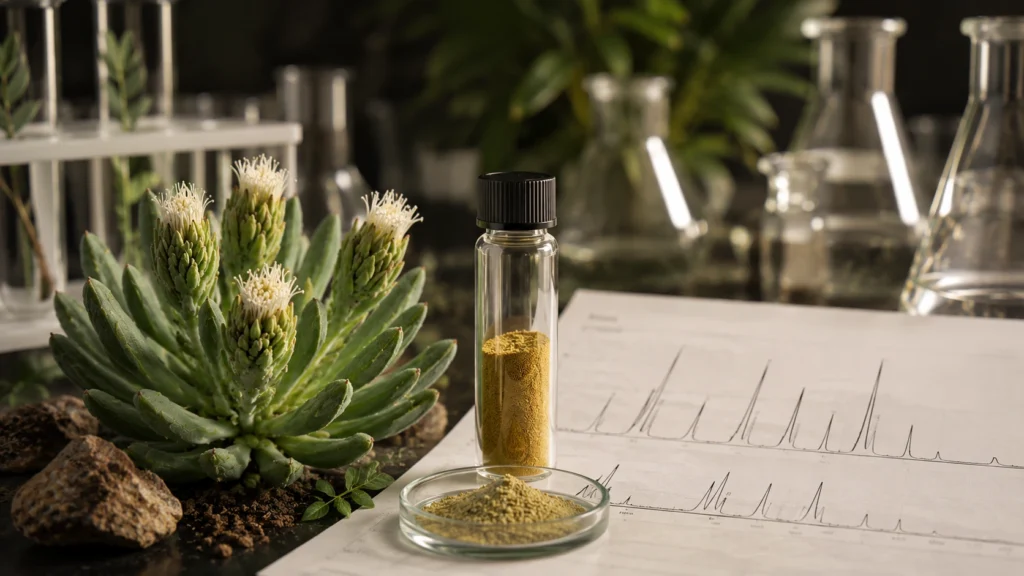
An HPLC chromatogram is the visual result produced by an HPLC analysis. It usually shows a series of peaks. Each peak may represent a compound detected in the sample.
In kanna analysis, peaks may correspond to mesembrine, mesembrenone, mesembrenol or related alkaloids, depending on the method and reference standards used.
A chromatogram can help laboratories understand:
- Which compounds are present
- Approximate or measured compound levels
- Whether the material matches an expected profile
- Whether unusual or unexpected peaks appear
- Whether the batch is consistent with previous batches
For botanical quality control, this kind of chemical fingerprint can be extremely useful.
Research on chromatographic fingerprint analysis for herbal medicine standardization explains how qualitative and quantitative fingerprinting methods can support quality control across different stages of herbal production.
What Is Alkaloid Profiling?
Alkaloid profiling means analyzing the alkaloid composition of a botanical material.
For kanna, this usually means looking at compounds such as:
- Mesembrine
- Mesembrenone
- Mesembrenol
- Mesembranol
- Δ7-mesembrenone
- Related mesembrine-type alkaloids
A single number, such as “5% alkaloids,” can be useful, but it does not always explain the full chemical profile. Two extracts may have the same total alkaloid percentage but different proportions of individual alkaloids.
This is why alkaloid profiling is helpful. It gives a more detailed view of the material than a simple ratio or general strength claim.
For technical, botanical and analytical use, a standardized kanna extract with defined alkaloid information can be easier to compare across batches than a non-standardized powder or ratio extract.
HPLC vs LC-MS, GC-MS and Other Analytical Methods
HPLC is one of the most commonly discussed methods in botanical quality control, but it is not the only analytical technique.
Other methods may include:
- LC-MS
- GC-MS
- NMR spectroscopy
- HPTLC
- Capillary electrophoresis-mass spectrometry
Each method has different strengths.
HPLC is widely used for separation and quantification of compounds. LC-MS combines liquid chromatography with mass spectrometry, giving more detailed compound identification. GC-MS is useful for volatile or derivatized compounds. NMR can provide structural information. HPTLC is often used for botanical fingerprinting and identity testing.
A study on forensic analysis of mesembrine alkaloids in Sceletium tortuosum described the use of nonaqueous capillary electrophoresis coupled to mass spectrometry for analyzing complex alkaloid mixtures in Sceletium samples.
For most buyers, the most important point is not the name of the method alone. It is whether the supplier provides clear, batch-specific testing information that supports the product specification.
What Is a Certificate of Analysis?
A Certificate of Analysis, often shortened to COA, is a document that provides batch-specific testing information.
For botanical extracts, a COA may include:
- Product name
- Botanical name
- Batch or lot number
- Manufacturing date or test date
- Extract ratio
- Standardization level
- Alkaloid percentage
- Test method
- Microbiological results
- Heavy metal screening
- Pesticide residue testing
- Residual solvent information
- Analyst or laboratory details
A COA is useful because it connects a product specification to a specific batch. This is important because botanical materials can vary naturally.
A product page may describe a general specification, but a COA helps confirm what was tested for a particular batch.
When comparing Sceletium tortuosum kanna extracts, customers should look for clear product information and batch-focused documentation where available.
Why Batch Numbers Matter
A batch number connects a physical product to its production and testing record.
This matters because botanical materials are not always identical from one production run to the next. Even when the same plant species and extraction method are used, natural variation can still occur.
A batch number helps trace:
- When the material was produced
- Which raw material lot was used
- Which testing report applies
- Whether the batch passed specification
- Whether the product can be compared with previous batches
For suppliers, batch tracking is part of responsible quality control. For buyers, it provides better transparency.
Without a batch number, it is harder to connect a product to a specific COA or analytical result.
Botanical Identity Testing
Before discussing alkaloid percentage, it is important to confirm botanical identity.
For kanna products, this means confirming that the material is correctly identified as Sceletium tortuosum or another clearly stated Sceletium species.
Botanical identity can be supported through several approaches:
- Supplier documentation
- Macroscopic or microscopic plant analysis
- Chromatographic fingerprinting
- Chemical marker analysis
- DNA-based methods in some contexts
A PubMed-indexed study on herbal quality control using HPTLC and hyperspectral imaging investigated quality control approaches for Sceletium species and described the use of chromatographic data and biomarkers to distinguish botanical material.
Correct identity matters because different species, plant parts or incorrectly labelled materials may produce different chemical profiles.
Heavy Metals, Microbiology and Pesticide Testing
Quality control is not only about alkaloids.
Botanical materials may also be tested for contaminants. This can include:
- Heavy metals
- Microbiological contamination
- Pesticide residues
- Residual solvents
- Foreign matter
- Moisture content
These tests help evaluate whether the material meets defined quality specifications.
For botanical extracts, contaminant testing is especially important because plant materials can be affected by soil, water, processing, storage and handling conditions.
A strong COA should make it clear what was tested, which method was used and whether the batch passed the stated limits.
For technical and analytical buyers, this type of information can be just as important as alkaloid percentage.
Why “Lab Tested” Is Not Enough
Many botanical products are described as “lab tested.” But this phrase alone does not tell you very much.
A better question is:
Tested for what?
For kanna extracts, useful testing information may include:
- Botanical identity
- Alkaloid profile
- Total alkaloid percentage
- Mesembrine-type alkaloids
- Microbiology
- Heavy metals
- Pesticides
- Residual solvents
- Batch number
- Test method
The phrase “lab tested” is only meaningful when it is supported by specific information.
A product that says “lab tested” without details gives less confidence than a product with a clear COA, stated test methods and defined specifications.
How to Read a Kanna COA
When reviewing a COA for kanna extract, start with the basics.
First, check the product identity:
- Does the COA say Sceletium tortuosum?
- Does it match the product name?
- Does the batch number match the product batch?
Second, check the specification:
- Is it a powder, ratio extract or standardized extract?
- Does it list total alkaloids?
- Does it list individual alkaloids?
- Does it state the test method?
Third, check safety and contaminant parameters:
- Are heavy metals listed?
- Are microbiological results listed?
- Are pesticide results listed?
- Are residual solvents relevant?
Fourth, check the dates:
- When was the test performed?
- Is the COA tied to the current batch?
- Is the document complete and readable?
A COA does not need to be complicated, but it should be specific enough to support the product’s stated quality claims.
COA vs Product Specification
A product specification and a COA are related, but they are not the same thing.
A product specification describes what the product is expected to meet.
A COA reports testing information for a specific batch.
For example, a product specification might state:
- Sceletium tortuosum extract
- Standardized to 5% total alkaloids
- Powder form
- Botanical raw material
A COA may then report whether a particular batch met that specification.
This distinction is important because a product claim should ideally be supported by batch-specific testing.
For kanna botanical raw materials, clear specifications and COA availability help customers compare products more accurately.
Why Quality Control Supports Better Product Comparison
Without testing, kanna products can be difficult to compare.
One product may be labelled as powder. Another may be labelled 50:1 extract. Another may be standardized to a specific alkaloid level. These are different types of product information.
Quality control helps make comparison easier by answering practical questions:
- What is the botanical identity?
- What type of extract is it?
- What is the alkaloid profile?
- What is the total alkaloid percentage?
- Was the batch tested?
- Is documentation available?
This is especially useful for technical, botanical and analytical applications, where consistency and documentation may matter more than broad marketing descriptions.
Common Red Flags When Comparing Kanna Products
When comparing kanna products online, watch for vague or unsupported descriptions.
Potential red flags include:
- No botanical name
- No batch information
- No stated extract type
- No alkaloid specification
- No explanation of testing
- No COA availability
- Overly broad claims
- Confusing “ratio” with “alkaloid percentage”
- Claims that one extract is automatically superior based only on ratio
A transparent supplier should make it easy to understand what type of material is being sold and what documentation supports it.
For kanna, this is especially important because the chemical profile can vary significantly between powders, ratio extracts and standardized extracts.
Responsible Kanna Product Information
Responsible kanna product information should focus on:
- Botanical identity
- Extract type
- Alkaloid profile
- Standardization
- Testing
- Documentation
- Intended use
It should avoid unsupported claims or unclear statements about effects.
At EUKratom, our Sceletium tortuosum materials are offered as botanical raw materials for technical, botanical and analytical purposes. They are not sold for consumption.
Explore our Sceletium tortuosum botanical raw material and standardized kanna extracts to compare available product types and specifications.
Key Takeaways
HPLC testing, alkaloid profiling and Certificates of Analysis are important tools for understanding kanna extract quality.
A ratio such as 50:1 or 100:1 does not automatically confirm alkaloid percentage. A standardized extract with batch documentation provides more specific chemical information.
For Sceletium tortuosum, quality control should ideally include botanical identity, alkaloid analysis and relevant contaminant testing.
When comparing kanna products, look for clear specifications, batch numbers, COA availability and responsible product descriptions.
Frequently Asked Questions
What is HPLC testing for kanna?
HPLC testing is a laboratory method used to separate and measure compounds in kanna material. It can help analyze mesembrine-type alkaloids in Sceletium tortuosum extracts.
What does a kanna COA show?
A kanna COA may show product identity, batch number, extract ratio, alkaloid percentage, test method, microbiology, heavy metals, pesticides and other quality-control information.
Why does alkaloid profiling matter?
Alkaloid profiling helps describe the chemical composition of a kanna product. It can show whether the material contains expected mesembrine-type alkaloids and whether it matches its specification.
Is “lab tested” enough?
Not by itself. “Lab tested” is only useful when the supplier explains what was tested, which method was used and whether batch-specific documentation is available.
What is the difference between a COA and a product specification?
A product specification describes what the product is expected to meet. A COA reports testing results for a specific batch.
Why are batch numbers important?
Batch numbers connect a product to its production and testing records. They help verify which COA applies to a specific material.
References
Patnala, S. and Kanfer, I. HPLC analysis of mesembrine-type alkaloids in Sceletium plant material. 2010.
Noviana, E. et al. Advances in fingerprint analysis for standardization and quality control of herbal medicines. 2022.
Bārzdiņa, A. et al. The potential use of herbal fingerprints by means of HPLC and TLC for characterization and identification of herbal extracts. 2022.
Shikanga, E. A. et al. A novel approach in herbal quality control using HPTLC and hyperspectral imaging. 2013.
Roscher, J. et al. Forensic analysis of mesembrine alkaloids in Sceletium tortuosum by nonaqueous capillary electrophoresis mass spectrometry. 2012.

 Kratom
 Kratom Alternatives
 Kanna (Sceletium T.)
 Accessories
 Sale Products
 Wholesale
 Support
 Blog
Blog