 Blog
Blog


 Nederlands
 Deutsch
 Español
 Magyar
Kanna Alkaloids Explained: Mesembrine, Mesembrenone and Mesembrenol
Jun
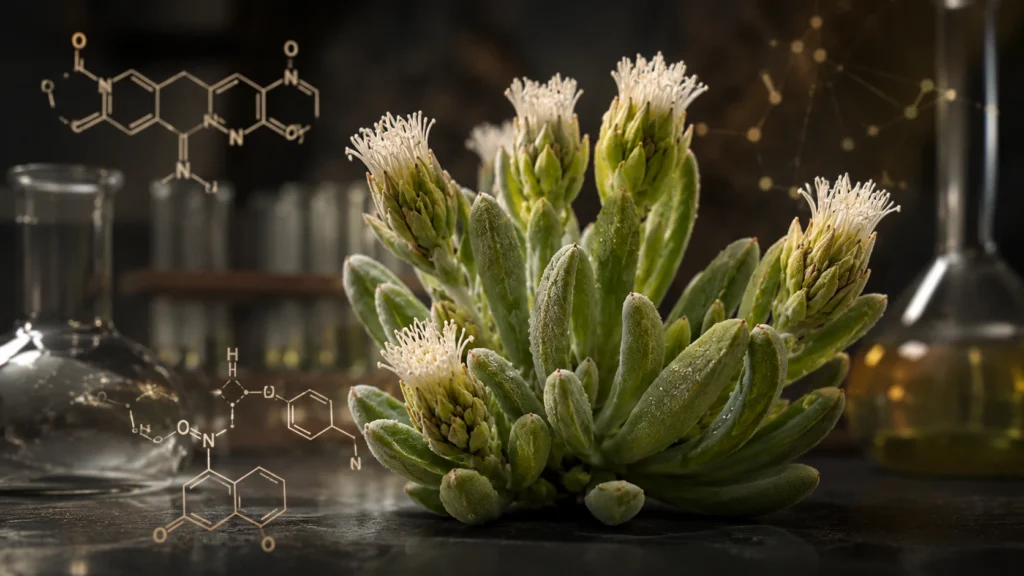
Kanna, botanically known as Sceletium tortuosum, is one of the most chemically interesting succulent plants in Southern African ethnobotany. Much of the modern scientific interest in kanna comes from its distinctive group of naturally occurring compounds known as mesembrine-type alkaloids.
These alkaloids are part of the plant’s chemical fingerprint and are especially important when comparing different forms of kanna material, including dried plant powder, ratio extracts and standardized botanical extracts.
For customers comparing technical-grade material, alkaloid information can help explain why a standardized Sceletium tortuosum extract is different from a simple powdered botanical raw material.
This article explains the key kanna alkaloids, why they matter, how they are studied and why laboratory testing is important for Sceletium tortuosum products.
What Are Kanna Alkaloids?
Alkaloids are naturally occurring nitrogen-containing compounds found in many plants. In Sceletium tortuosum, the most discussed alkaloids belong to a group often described as mesembrine-type alkaloids.
A scientific review of mesembrine alkaloids describes their chemistry, analysis and pharmacological research context. The review notes that mesembrine and mesembrenone are among the major alkaloids discussed in relation to Sceletium tortuosum.
The most commonly mentioned kanna alkaloids include:
- Mesembrine
- Mesembrenone
- Mesembrenol
- Mesembranol
- Δ7-mesembrenone
- Related mesembrine-type compounds
These compounds are important because they help define the chemical profile of the plant material. However, not every kanna product has the same alkaloid profile. The final composition can depend on plant genetics, growing conditions, harvesting, drying, fermentation, extraction method and standardization.
Why Kanna Alkaloid Profiles Matter
When people compare kanna products, they often focus on extraction ratios such as 10:1, 50:1 or 100:1. While these ratios can be useful, they do not necessarily tell the full story.
A ratio extract describes how much starting plant material was used to produce a smaller amount of extract. A standardized extract, on the other hand, is typically produced to meet a defined chemical specification.
For example:
- A 50:1 extract describes a concentration ratio
- A 5% alkaloid extract describes a measured chemical specification
- A COA-tested extract provides batch-specific analytical documentation
This is why alkaloid profiling matters. It gives a more meaningful way to compare Sceletium tortuosum materials than relying only on vague descriptions such as “strong” or “premium.”
For botanical, analytical and technical use, a standardized kanna extract can offer clearer product specifications and better batch-to-batch comparability.
Mesembrine: The Best-Known Kanna Alkaloids
Mesembrine is probably the most widely discussed alkaloid in Sceletium tortuosum. It is often used as a marker compound when describing the chemical profile of kanna materials.
In analytical and pharmacological literature, mesembrine has received attention because it appears prominently in many Sceletium extracts. Researchers have also studied its interaction with biological targets in laboratory models.
One important pharmacological study investigated the activity of Sceletium tortuosum alkaloids, including mesembrine, in relation to the serotonin transporter and phosphodiesterase-4. These findings are useful for understanding why mesembrine is scientifically interesting, but they should not be interpreted as product claims for all kanna materials.
The key point is that mesembrine is not the only relevant alkaloid. The overall alkaloid profile may be more informative than looking at a single compound in isolation.
Mesembrenone: Another Important Marker Compound
Mesembrenone is another major alkaloid associated with Sceletium tortuosum. Alongside mesembrine, it is frequently discussed in scientific studies and analytical reports.
A study using advanced analytical techniques such as GC-MS, LC-MS, LC-high-resolution-MS and NMR identified mesembrine and mesembrenone as main alkaloids of Sceletium tortuosum. These kinds of analytical methods are important because they allow researchers to study complex plant materials with greater chemical precision.
Mesembrenone is especially relevant in the context of standardized extracts because it may contribute to the overall alkaloid profile and help distinguish one extract type from another.
For customers, this means that two products labelled “kanna extract” may not be identical, even if they have a similar appearance. Their chemical fingerprints can differ significantly.
Mesembrenol and Related Alkaloids
Mesembrenol is another alkaloid commonly mentioned in relation to Sceletium tortuosum. It is part of the broader mesembrine-type alkaloid family and may appear in different proportions depending on the plant material and processing method.
Other related alkaloids may include mesembranol, Δ7-mesembrenone and additional compounds found in smaller amounts. Together, these molecules contribute to what is often called the plant’s alkaloid profile.
Modern metabolomic research has shown that Sceletium species can be chemically complex. A 2022 study using liquid chromatography-mass spectrometry provided a metabolomic characterization of Sceletium tortuosum and related species, highlighting how chemical profiling can help distinguish species that may be difficult to identify by morphology alone.
This is especially important in botanical quality control. A product should not only be labelled correctly; it should also be chemically consistent with the claimed botanical material.
How Are Kanna Alkaloids Measured?
Kanna alkaloids can be studied using several analytical techniques. These methods are used to identify, separate and quantify compounds within a plant material or extract.
Common analytical methods include:
- HPLC
- LC-MS
- GC-MS
- NMR spectroscopy
- Capillary electrophoresis-mass spectrometry
One study on HPLC analysis of mesembrine-type alkaloids in Sceletium plant species focused on analytical methods for measuring these compounds. HPLC is especially useful in commercial quality control because it can help quantify marker compounds and verify whether a material matches its stated specification.
Another study examined forensic analysis of mesembrine alkaloids using nonaqueous capillary electrophoresis mass spectrometry. While this is a more specialized analytical method, it shows how important accurate alkaloid identification can be in scientific and forensic contexts.
For suppliers and buyers, these studies support a simple but important point: kanna quality should be based on testing and documentation, not just marketing language.
Kanna Powder vs Standardized Alkaloid Extract
Standardized kanna and Kanna powder are not the same thing.
Kanna powder usually refers to dried and ground Sceletium tortuosum plant material. It may contain naturally occurring alkaloids, but the exact concentration can vary from batch to batch.
Kanna extract refers to material that has undergone an extraction process. Extracts can be described by ratio, such as 10:1, 50:1 or 100:1.
Standardized kanna extract is produced to meet a defined chemical specification, such as a stated percentage of total alkaloids.
This distinction matters because a ratio alone does not confirm the level of mesembrine, mesembrenone or other alkaloids. A standardized extract with laboratory documentation provides more useful information for technical comparison.
When reviewing Sceletium tortuosum botanical raw materials, customers should look for clear information about extract type, alkaloid percentage and testing documentation.
Why “Stronger” Is Not Always a Useful Description
In botanical commerce, products are often described as “strong” or “potent.” However, these terms can be vague.
For kanna materials, a more useful approach is to ask:
- What species is the material from?
- Is it powder, ratio extract or standardized extract?
- Which alkaloids are being measured?
- What is the total alkaloid percentage?
- Is there batch-specific testing?
- Is a Certificate of Analysis available?
A product described as “100:1” is not automatically more useful than a product standardized to a known alkaloid percentage. The most important factor depends on the intended technical or analytical application.
This is why standardized lab documentation is often more meaningful than general strength claims.
What Is a Certificate of Analysis?
A Certificate of Analysis, often called a COA, is a batch-specific document that provides analytical information about a product. For botanical extracts, a COA may include details such as:
- Product name
- Batch number
- Botanical identity
- Extract ratio or standardization
- Alkaloid content
- Microbiological results
- Heavy metal screening
- Pesticide residue testing
- Date of analysis
For kanna extracts, a COA can help verify whether the material matches its stated alkaloid specification. This is especially useful for customers comparing technical-grade Sceletium tortuosum products.
At EUKratom, Sceletium tortuosum materials are offered as botanical raw materials for technical, botanical and analytical purposes. They are not sold for consumption.
You can view our Sceletium tortuosum botanical raw material and standardized kanna extracts for more information about available product types and specifications.
Responsible Interpretation of Kanna Research
Scientific research on kanna alkaloids is valuable, but it must be interpreted carefully.
Studies may examine isolated compounds, specific standardized extracts, laboratory assays or advanced analytical methods. These results do not automatically apply to every commercial product labelled as kanna.
A responsible approach is to separate:
- Botanical identity
- Traditional ethnobotanical context
- Alkaloid chemistry
- Analytical testing
- Laboratory pharmacology
- Commercial product specifications
This distinction helps avoid exaggerated claims and supports a more accurate understanding of Sceletium tortuosum as a botanical raw material.
For SEO and education, this is also a stronger long-term strategy. Instead of relying on unsupported claims, kanna content should focus on clear botanical information, transparent testing and scientific references.
Key Takeaways
Kanna alkaloids are central to understanding Sceletium tortuosum. The most widely discussed compounds include mesembrine, mesembrenone and mesembrenol, but the full alkaloid profile can be more important than any single compound.
For buyers comparing kanna products, the most important details are product type, standardization, analytical testing and batch documentation.
A standardized extract with a defined alkaloid percentage is not the same as a basic ratio extract or dried plant powder. This makes alkaloid profiling one of the most important topics in modern kanna product education.
Frequently Asked Questions About Kanna Alkaloids
What are the main alkaloids in kanna?
The most commonly discussed kanna alkaloids include mesembrine, mesembrenone, mesembrenol and mesembranol. Other related mesembrine-type alkaloids may also be present.
What is mesembrine?
Mesembrine is one of the best-known alkaloids found in Sceletium tortuosum. It is often used as a marker compound in discussions of kanna’s chemical profile.
What is mesembrenone?
Mesembrenone is another important alkaloid found in Sceletium tortuosum. It is frequently studied alongside mesembrine and may contribute to the overall alkaloid profile of an extract.
Why does alkaloid percentage matter?
Alkaloid percentage provides a more specific chemical measurement than a simple extraction ratio. It can help customers compare standardized botanical extracts more accurately.
Is a 100:1 kanna extract the same as a 5% alkaloid extract?
No. A 100:1 extract describes an extraction ratio, while a 5% alkaloid extract describes a measured chemical specification. These are different types of product information.
How are kanna alkaloids tested?
References
Krstenansky, J. L. Mesembrine alkaloids: Review of their occurrence, chemistry, analysis and pharmacology. 2017.
Patnala, S. and Kanfer, I. HPLC analysis of mesembrine-type alkaloids in Sceletium plant species. 2010.
Meyer, G. M. J. et al. GC-MS, LC-MS, LC-high resolution-MS and NMR analysis of Sceletium tortuosum alkaloids. 2015.
Reddy, K. et al. Mass spectrometry metabolomics and feature-based molecular networking of Sceletium tortuosum and related species. 2022.
Roscher, J. et al. Forensic analysis of mesembrine alkaloids in Sceletium tortuosum by nonaqueous capillary electrophoresis mass spectrometry. 2012.
Harvey, A. L. et al. Pharmacological actions of Sceletium tortuosum and its principal alkaloids. 2011.

 Kratom
 Kratom Alternatives
 Kanna (Sceletium T.)
 Accessories
 Sale Products
 Wholesale
 Support
 Blog
Blog