 Blog
Blog


 Nederlands
 Deutsch
 Español
 Magyar
Sceletium tortuosum Kanna: History, Botany, Scientific Interest
May
A Plant With a Long Cultural History
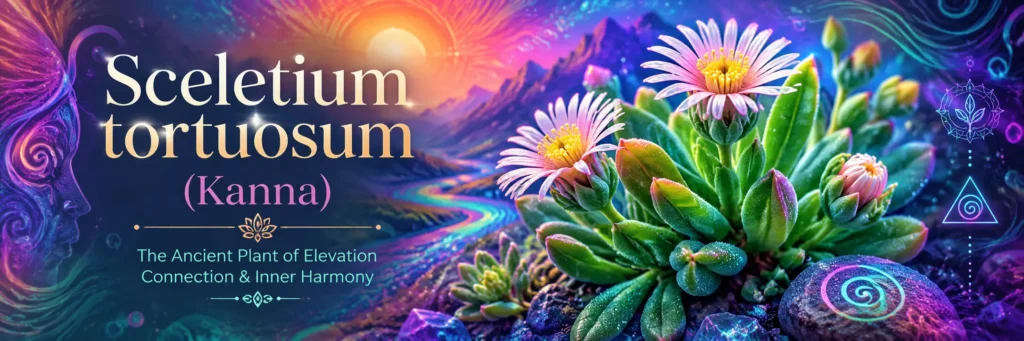
Sceletium tortuosum, commonly known as Kanna or Kougoed, is a succulent plant native to parts of Southern Africa, especially South Africa. It belongs to the Aizoaceae family, which includes many drought-tolerant plants adapted to dry environments.
In addition, Kanna has a long cultural history and contains naturally occurring alkaloids. For this reason, researchers have become interested in the plant within ethnobotany, plant chemistry, and modern botanical research.
Kanna is not a modern discovery. Instead, people have documented it in relation to Southern African traditional plant knowledge for centuries. Traditional names such as Kanna and Kougoed also reflect the plant’s cultural importance in the region.
Today, people often discuss Sceletium tortuosum in connection with botany, traditional plant use, natural compounds, and scientific research.
Botanical Characteristics
Kanna is a low-growing succulent with fleshy leaves. Like many succulents, it stores water in its tissues, which helps it survive in dry and semi-arid landscapes.
- Fleshy green leaves
- Compact, low-growing form
- Adapted to dry and semi-arid environments
- Member of the Aizoaceae plant family
- Native to parts of Southern Africa
Active Compounds in Kanna
One of the most studied aspects of Sceletium tortuosum is its alkaloid profile. In particular, researchers often focus on a group of naturally occurring compounds known as mesembrine alkaloids.
These include:
- Mesembrine
- Mesembrenone
- Mesembrenol
- Mesembranol
These compounds are one reason the plant has attracted attention in modern plant science. However, research mainly focuses on the plant’s chemical profile and possible biological mechanisms.
Current Research on Sceletium tortuosum
Scientific interest in Sceletium tortuosum has grown in recent years. Researchers have looked at its phytochemistry, traditional use, and biological properties.
For example, a scientific review published in Molecules discusses Sceletium tortuosum in relation to several research areas, including antioxidant, anti-inflammatory, antimicrobial, and nervous-system-related activity.
However, much of the research is still exploratory. Therefore, Kanna should be described as a scientifically interesting plant, not as a proven medical solution.
Modern plant science often studies traditional plants to better understand their chemical composition and biological activity. As a result, Kanna has become a useful example of a plant that connects traditional knowledge with contemporary research.
Researchers are especially interested in how its alkaloids may interact with biological systems. Nevertheless, further studies still need to clarify safety, standardization, mechanisms, and possible future applications.
Why Kanna Is Gaining Attention
Kanna has gained attention for several reasons. First, it has a long history in Southern Africa. Second, it contains a distinctive alkaloid profile. Finally, it has become relevant in discussions about ethnobotany and botanical research.
For people interested in traditional plants and natural compounds, Sceletium tortuosum remains a noteworthy subject.
View our botanical research kanna products.
Sustainability and Respect for Origin
When discussing a plant with cultural roots, it is important to consider sustainability, ethical sourcing, and respect for origin. Kanna is part of Southern Africa’s botanical and cultural heritage.
- Respect the plant’s cultural background
- Support sustainable cultivation and sourcing
- Use careful and accurate scientific language
- Avoid exaggerated or unsupported claims
- Acknowledge the importance of traditional knowledge
Summary
Sceletium tortuosum Kanna is a South African succulent with a long cultural history and growing scientific relevance. It contains several naturally occurring alkaloids, especially mesembrine-related compounds, which researchers study in plant chemistry and biological research.
Overall, a responsible approach works best: respect the tradition, acknowledge the science, and clearly separate current research from unsupported health claims.
Frequently Asked Questions About Kanna
What does Sceletium tortuosum Kanna mean?
Sceletium tortuosum is the botanical name of the plant. Kanna is one of its traditional common names.
Where does Kanna come from?
Kanna is native to parts of Southern Africa, especially South Africa, where it grows in dry and semi-arid environments.
Why is Kanna scientifically interesting?
The plant contains naturally occurring alkaloids such as mesembrine, mesembrenone, mesembrenol, and mesembranol. Because of this, researchers study these compounds for their chemical and biological relevance.
Is research on Kanna complete?
No. Although scientific interest is growing, researchers still need more studies to fully understand the plant’s properties, mechanisms, standardization, and safety profile.
Is Sceletium tortuosum the same as Kougoed?
Yes. Kougoed is a traditional name for Sceletium tortuosum in Southern African contexts.
Check our Featured products!


 Kratom
 Kratom Alternatives
 Kanna (Sceletium T.)
 Accessories
 Sale Products
 Wholesale
 Support
 Blog
Blog